

Test Papers – National Board Exam (IX-X)
NCERT Solutions for Class 9 Maths Chapter 5 – Introduction to Euclid’s Geometry
Euclidean geometry is the study of plane and solid figures on the basis of axioms and theorems employed by the Greek mathematician Euclid. In its rough outline, Euclidean geometry is the plane and solid geometry commonly taught in secondary schools. For details
class 9 maths chapter 5 solutions can be referred to.
Euclid’s axioms· Things which are equal to the same thing are also equal to one another. · If equals be added to equals, the wholes are equal. · If equals be subtracted from equals, the remainders are equal. · Things which coincide with one another are equal to one another. · The whole is greater than the part. |
Euclid’s Postulates
- To draw a straight line from any point to any point.
- To produce a finite straight line continuously in a straight line.
- To describe a circle with any center and distance.
- That all right angles are equal to one another.
- That if a straight line falling on two straight lines makes the interior angles on the same side less than two right angles, the straight lines, if produced indefinitely, will meet on that side on which the angles are less that two right angles.*
Two Equivalent versions of Euclid’s fifth postulates
There are three hypotheses which are
- hypothesis of right angles
- hypothesis of obtuse angles
- hypothesis of acute angles
- The first hypothesis is called as play fair’s axiom which is equivalent version of Euclid’s fifth postulate.
The second hypothesis states that a piece of straight line can be extended. The hypothesis of acute angle is extremely false because the acute angles are repulsive to the straight line.
NCERT Solutions for Class 9 Maths Chapter 4 – Linear Equations in Two Variables
Linear equations with two variables class 9 covers introduction and methods of solving linear equations with two variables
We all know about linear equation with one variable can be represented as
ax = b where a, b are constants and x is a variable.
Linear Equations with Two Variables will have two variables, it can be represented as
ax+by = c where a, b, c are constants and x, y are variables
Linear equations with two variables can be solved by a number of methods as mentioned below
- Graphing Method
- Substitution method
- Elimination method
Graphing Method
Inorder to solve Linear equations with two variables, the students have to learn rectangular axes for linear equation graph and Quadrants of Rectangular Axes. The students will get consistent and inconsistent equations which helps in solving the variable
Substitution Method
In this method the variables are substituted with one another to get the value of the two variables. Once the value of one variable is obtained, by substituting the value of one variable the value of other variable can be obtained. When value of both the variables is placed in the equation, a balanced equation indicates right solution.
Elimination Method
In this method, the two equations are multiplied with an appropriate number such that one of the variants gets nullified because of the negative signs. By solving the equation after multiplying will give you value of one variable. By substituting the value of obtained variable, the value of the other variable can also be obtained.
Download NCERT solutions for class 9 Maths chapter 4 pdf to allow easy availability of the study material.

NCERT Solutions for Class 9 Maths Chapter 3 – Co-ordinate Geometry
Coordinate Geometry
- Introduction
- Cartesian System
- Plotting a Point in the Plane if its Coordinates are Given and
- Summary
The position of an object on a plane can be defined with the help of coordinate geometry.
What are coordinates?
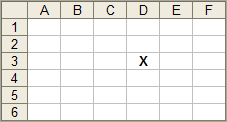
Consider a plane which is continuous in both the directions. One direction can be defined as rows and the other as columns. The object can be written as D3. The letter and the numerical are called as coordinates of the box. It helps in defining a place where the lines intersect.
The Coordinate Plane: A surface with two scales one across the plane which is x-axis and the other plane which is perpendicular to x-axis is y-axis.
x-axis, values to the right are positive and to the left are negative.
y-axis, values above the origin are positive and below are negative.
The center point is referred as origin. The position of the object is pointed with the number value on axis and on y –axis. The values of x and y are the co-ordinates of the object and is also called as “rectangular coordinates”. The first co-ordinate represents value of x-axis.
Importance of Coordinate Geometry
Coordinate geometry can be helpful in following situations
- Calculating distance between the co-ordinates
- Determination of slope and equation of the line segment
- Determine lies parallel or perpendicular
- Equations of curves, circles and ellipses.
You can also download the NCERT solutions for class 9 maths chapter 3 pdf, Coordinate Geometry. Solve the questions as given at the end of the chapter to master the subject.

NCERT Solutions for Class 9 Maths Chapter 2 – Polynomials
If any given expression has more than three terms, then the expression is called as polynomials.
Types of Polynomials:
The polynomials can be classified based on the number of terms as given below
Monomial:
The polynomial with only one term is monomial
Eg: It’s a number or a number with variable
Binomial:
The polynomial with only two terms is Binomial
Eg: It has 2 monomials separated by positive or negative signs
Trinomial:
The polynomial with only 3 terms is Trinomial
Eg: It has 3 monomials separated by positive or negative signs
Constant Polynomial:
The polynomial with only constant term is Constant Polynomial
Polynomial:
The polynomial with more than 3 terms is polynomial
Eg: It has more than 3 monomials separated by positive or negative signs
Remainder Theorem
It is also called as little Bézout’s theorem
The remainder theorem can be in a very simple way as follows
Inorder to find the value of the function f(x) for a given number, n
Divide the function by x- n
The result obtained will be f(n)
Note: the remainder theorem work only function is divided by linear polynomial.
The polynomial can be positive or negative number
Factorization of Polynomials or polynomial factorization:
It is a chapter important in Maths and Computer Algebra. It is a method in which the polynomial with coefficients in a given filed is obtained after multiplication of irreducible factors with coefficients in the same domain.
Study NCERT solutions for class 9 maths chapter 2 pdf in simple and easy to understand language. Understand the types of Polynomials well; this will help in studying the chapter without doubts.

NCERT Solutions for Class 9 Maths Chapter 1 – Number Systems
NCERT solutions for class 9 maths chapter 1 pdf, Number system covers the major topics rational numbers, irrational numbers and decimal expansion of real numbers.
Rational Numbers:
The rational numbers can be positive, negative, in the form of fraction or zero.
The word rational is derived from the word ration, which can be given as fraction. Ratio compares two numbers. Rational numbers are often referred as simple fractions; this is because an integer divided by another integer can be expressed as fraction.
Examples: 1/5 is a rational number
This is because an integer is divided by another. 1 is divided by 5
1 ½ is also a rational number.
This is because we can write it as 3/2. 3 is divided by 2
Irrational Numbers:
As the name says, it cannot be written as fraction or ratio between two numbers. The irrational numbers will continue without any repetition.
Examples: Pi i.e. 3.14 is the commonly used irrational number in Maths. It is used in calculating the circumference of the circle. There is no pattern of repetition in Pi after detailed analysis.
e, also known as Euler’s number plays an important role in the subject of compound interest. The value of number is 2.71828. e is the limit of (1 + 1/x)x as x. where x is infinity
Decimal expansion of real numbers:
The decimal expansion of a number is its representation in base-10 (i.e., in the decimal system). The “decimal place” consists of a digit 0-9 multiplied by a power of 10.
A decimal representation of a non-negative real number n is an expression in the form of a series. These are of 3 types Terminating, non-terminating repeating and non-terminating non-repeating

NCERT Solutions for Class 9 Maths Chapter 11 – Constructions
The chapter 11 of Class 9 is Constructions. We provide step-by step guide for all the questions in a simple way which helps students to understand the chapter better. The chapter covers the topic of basic constructions and constructions of triangle.
The word “construction” refers to the drawing of various shapes, lines and angles as per the dimensions in an accurate manner. The constructions of these objects are made with the help of a pencil and a ruler. Basically in Geometric constructions there are no numbers required or provided. Some of the common forms of construction are
- Bisector of a given angle
- Construction of a perpendicular bisector of a given line segment
- Construction of angles at any given point in a ray
The other important topic which is covered under NCERT Solutions For Class 9 Maths Chapter 11 PDF is construction of triangles. The major topics under this subheading are
- Rules of congruency of triangles
- Uniqueness of triangle
Important constructions which are covered under NCERT Solutions For Class 9 Maths Chapter 11 PDF are
- Constructing a triangle based on the given base, base angle and sum of two sides of a triangle
- Constructing a triangle based on the given base, base angle and difference of other two sides of a triangle
Constructing a triangle based on the given perimeter, its two base angles