

State Board Commerce (XI-XII) - Test Papers
MHT-CET 2019 Sample Test Paper – Math
For Solutions Please Click here
MHT-CET 2019 Sample Test Paper – Chemistry & Physics
For Solutions Please Click here
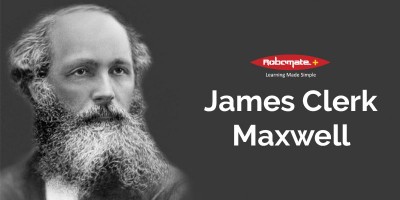
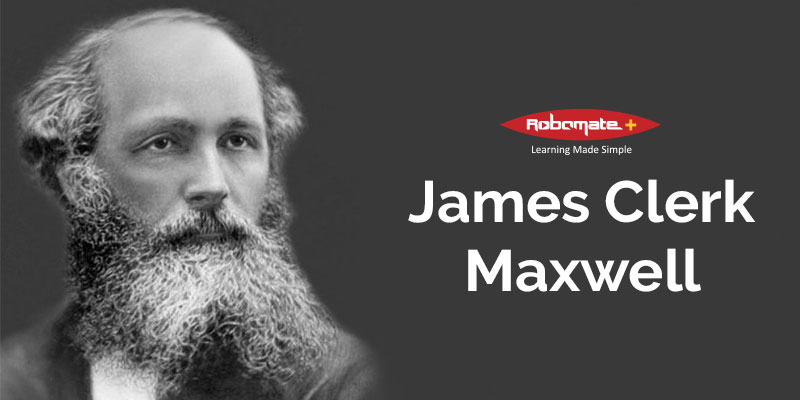
James Clerk Maxwell
The famous physicist James Clerk Maxwell was born on June 13, 1831, in Edinburgh, Scotland. He is considered as the scientist of the 19th century as he has laid the foundation for the important concepts of electromagnetic theory.
Light is an electromagnetic radiation whose wavelength can vary from visible to non-visible spectrum. The electromagnetic waves are of different types such as radio waves, microwaves; infrared, visible and ultraviolet light; X-rays, gamma rays etc.
James Clerk Maxwell Findings
Maxwell was the first scientist who bought all the established physics law of Gauss, Faraday, Ampere, and Fourth law. Maxwell studied Faraday’s work and demonstrated the speed of an electromagnetic wave travels at the speed of light. Maxwell incorporated laws of light, magnetism, and electricity into one theory which originated into electromagnetic theory.
Maxwell’s findings were published in 1873 ‘Treatise on Electricity and Magnetism’. He noted the propagation of light in electric and magnetic waves is perpendicular to each other. The electromagnetic theory has paved the wave for many technological innovations in the field of electricity. The electromagnetic waves are arranged as per the frequency and wavelength. The electromagnetic waves are propagated in the space in the form of sinusoidal waves.
Heinrich Hertz was the first person to utilize the principle of Maxwell to develop equipment for sending and receiving radio pulses. Based on James Clerk Maxwell theory today’s must-haves, television and microwave were created. Human life is not imaginable with electronic devices.
The James Clerk Maxwell is often compared with the famous scientist Sir Isaac Newton and Albert Einstein for his contributions of the fundamentals of nature.
He expired on November 5, 1879, Cambridge, Cambridgeshire, England.
James Clerk Maxwell Achievements:
• The Maxwell (Mx), a CGS unit measuring magnetic flux i
• James Clerk Maxwell Prize in Plasma Physics of the American Physical Society [120]
• IEEE Maxwell Award
• A mountain range in the planet Venus is named after him and Rings of Saturn is known as Maxwell Gap
• The James Clerk Maxwell Telescope is the largest submillimetre-wavelength astronomical telescope
• The Maxwell Centre at the University of Cambridge
• The James Clerk Maxwell Science Centre of the Edinburgh Academy
Watch Video Lectures of your Course for Free

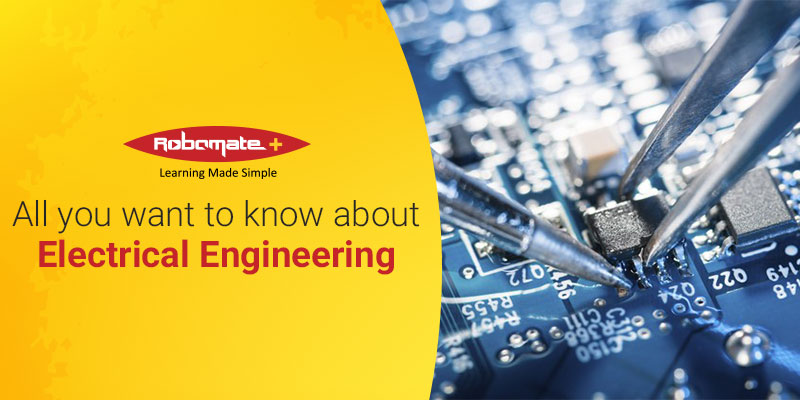
All you want to know about Electrical Engineering
Electrical engineering is all about electricity, electronics, and electromagnetism. It is a vast field which is sub-divided into different fields such as electronics, microelectronics, digital computers, computer engineering, power engineering, telecommunications, etc. They utilize the equipment ranging from voltmeter to a high-end analyzer. Being an electrical engineer is a challenging job and the candidates are required to master their theoretical and practical skills and knowledge to be successful in the field.
Job Profile of Electrical Engineer:
Before taking any field, students will be eager to know the job profile and the scope. Here we give you the job profile
- Designing of electrical systems
- Development and testing of electrical components
- Evaluation of electrical systems with the knowledge of electricity and materials, an electrical engineer should be able to design and conduct research based on the existing systems.
- Evaluate the electrical systems and its components for capabilities and defining the testing methods and testing properties.
- An electrical engineer is responsible for developing and designing the system and its components for its capabilities as per the requirements of the organization. They will be responsible for designing and modifying the stand electrical systems for building and assembling of electrical components and ease operators functioning
- Manufacture and assembly of the materials and development of procedures for research and testing
- Development of methods and procedures for assessing the product quality of the finished products and the system qualities
- It is not just developing and designing methods but also making periodic product reports by collecting and summarizing the information of the finished product system and the system capabilities.
- Answering customer questions and queries and develops procedures for taking feedback from the customer of its electrical components. Develop procedures for the operation of equipment for the manufacturer’s instructions and the procedures to overcome troubleshooting. The customer can request repair service.
- Maintenance of product quality and comply with the local federal and state regulations
- Training and guidance of the newly hired technicians
- Maintenance of data about the product
An electrical engineer should keep the knowledge up to date by attending educational workshops, professional societies, publications, and personal networks.

Top Electrical Engineering Colleges in India
- IIT Bombay – Indian Institute Of Technology
- IIT Delhi – Indian Institute Of Technology
- Indian Institute of Technology, Kharagpur
- Birla Institute of Technology and Science
- IIT Madras – Indian Institute of Technology Chennai
- DTU – Delhi Technological University
- Anna University
- National Institute of Technology, Surathkal
Subjects in Electrical Engineering
Electrical engineering is a vast subject which covers various topics involved in the field of electric instruments including daily use of electrical items. The major subjects in Electrical Engineering are
- Basics of Electronics Engineering
- Electrical machines
- Fiber-optics
- Introduction to manufacturing processes
- Opto-Electronics
- Power generation
- Power Systems
- Semiconductor Devices Technology
- Signals systems and networks
Top Companies Hiring Electrical Engineers
Well established and reputed colleges are often a place for branded companies to absorb the young budding talent of the country. The companies visit the campus and interview the candidate for their knowledge and skill and select them for a good package. Most companies also offer a stipend to candidates during their training period. Here we list you the top companies which offer campus placements
- Bajaj International Private Ltd
- Bharat Heavy Electricals Limited (BHEL)
- Crompton Greaves Limited (CGL)
- Dev Denso Power Ltd
- Info Edge (India) Ltd
- Penguin Engineering Ltd
- Bristol Fire Engineering
- Kelvin Electrical
- Siemens Ltd
- Wipro Lighting.
Skills Required for an Electrical Engineer:
Here we list the skills required for an electrical engineer
Critical thinking: Electrical engineers should analyze their strengths and weaknesses and device procedures to solve problems. Critical thinking helps you in assessing the situation and get the best result out of it.
Functioning of circuits: The entire concept of electrical engineering is based on the circuits, as a student of electrical engineering, the staff makes sure that the student is well-trained about the functioning of are clear about the design and fixing of circuits.
Electrical Measurements: the flow of electrical current in the circuits and how the components of the circuit react to one another defines the functioning. Electrical measurements help in devising new electronic devices and also repair of the old electronic devices. The Candidates should be well-versed with the knowledge to read and manipulate the electrical instruments. The right quantity of electricity in the electronic device is required. Less electricity may not produce the desired effect and high may explode the device, an electrical engineer should be in a position to define the amount of electricity which can be flown in the circuit to allow easy and smooth functioning of the device.
Apart from the technical skills, the candidate should be a quick learner, have good interpersonal communication skills, Organizational Skills, and innovative thinking
Programming Languages: The programming languages C/C++ and MATLAB are important to understand the embedded system, analyzing data and designing circuits. To work and design various electronic devices programming languages are very important for designing circuits and solving equations.
Entrance Exams and Admission:
Candidates who intend to take admission in electrical engineering can write state level or national level entrance exams such as JEE Main, JEE Advanced and BITSAT. In addition, the candidates can get direct admission into the colleges and in the management quota, NRI candidates are also eligible for admission. It is mandatory for the candidates to pass 10+2 to get admission into the 4-year engineering program. Diploma holders can also seek admission into 4 years course.
Courses:
The candidates have the option f doing diploma in electrical engineering or 4 years degree course depending upon the students’ choice. Diploma holders can change join the bachelor’s degree program after completion by writing the lateral entrance exam. A number of institutes are available which offer different courses (Diploma, Bachelor Degree or Master Degree or Advanced Diploma) in electrical engineering. Before selecting the course make a note that your profile and package will depend upon your qualification. Here we list the programs for electrical engineering
Diploma Course:
Candidates who have passed the board exam are eligible for doing diploma course. Diploma holders can change join the bachelor’s degree program after completion by writing the lateral entrance exam.
Duration – 2 to 3 years
Eligibility: should pass 10th class
Entrance: state polytechnic entrance exams.
Undergraduate Courses:
In order to be eligible for the bachelor’s program the candidate should have Physics, Chemistry, and Mathematics as their main subjects
Duration: 4 years
Eligibility: should pass 10 + 2 class
Entrance: state level entrance exams or JEE Advance or Mains
Master Courses:
Duration: Two-Year Master Degree program
Eligibility: The candidate should hold a bachelor’s degree in electrical engineering. Each college or institute has its predefined minimum aggregate in the subjects to get admission and the rank in the entrance exam. The candidates have to write GATE entrance test or by direct admission into the management, quota to apply for M. Tech courses.
Ph.D.:
Duration: Three to Five Year Degrees
Eligibility: The candidate should have a master degree in the relevant field in order to be eligible for course in the doctorate program.
Download Important Facts & Formulae for JEE
How to learn Maths Easily
Often students assume subject Maths as one of the difficult subjects and are afraid to solve a maths problem. Maths is an inevitable subject which will be taught throughout the school and also in graduation, although the difficulty level may be different. In reality, Maths is an easy subject provided you learn all the formulas and apply little logic as per the question. Dedicate a defined time schedule for maths and make sure you stick to the timetable. Here we provide you the easy way to learn maths.
Practice Maths Problems
This very important aspect to master the subject, we have heard the proverb “practices makes the man perfect”. It is very apt for this subject and provides an easy way to learn maths. It is not a subject which students can learn by reading and listening. Try to solve as many problems as possible to master the subject.
Usually, student find it more easy to grab the subject in the calmness of night as there will be little or no disturbance.

Formula Booklet for Math Studies
Every chapter has a defined set of formulas and theorems, maintain a separate book to by-heart the formulas. Keeping a separate book will give you easy access to the formulas. You can also make a chart of the formulas and paste it on the wall, so you will remember the formula and have a glance it whenever you pass the place. Include concepts, terminology, and definitions also in the formula book which makes it handy to revise before working on the problems.
Study Environment
Select a place where you find it peaceful to study. Avoid noisy places and where there is constant interference of people, television or outdoor activities. This distracts attention and will not let you concentrate on the subject.
Understand the concept
As stated it is not a subject of reading, it requires a step-by-step process to solve complex solutions. Maths tricks help in solving the problem in a short time and also verification of the solution.
Identify & Clarify Doubts
Identify your weak areas, the step which takes a long time to solve, understand the concept. You can approach your teacher or friends and develop problem-solving skills.
Practical Application of Maths
Geometry and the probability concept can be applied in real life. This makes the subject interesting for the students.
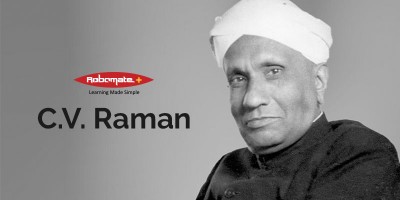
CV Raman Brief Biography
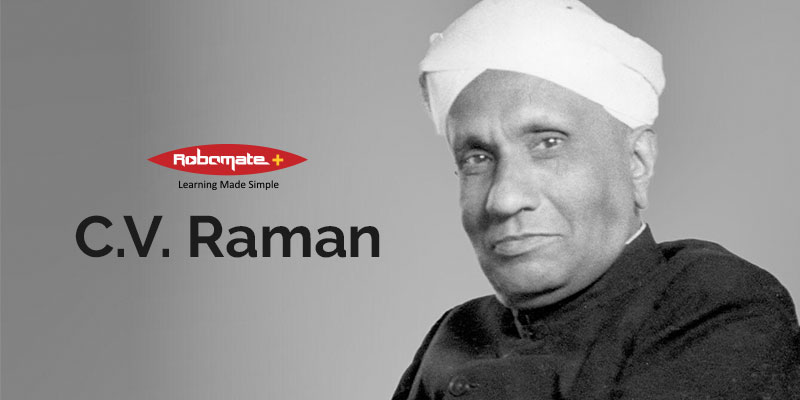
Brief Biography of CV Raman
Sir Chandrasekhara Venkata Raman popularly known as Sir CV Raman was born at Tiruchirappalli in Southern India on November 7th, 1888 during the British period. His father was a lecturer and he acquired the skills of Maths and Physics from him. He graduated from Presidency College, Madras (Now Chennai) , in 1902. He studied B.A. and M. A. with the highest distinctions.
While traveling to Europe, CV Raman noticed the blue color of glaciers and the Mediterranean Sea. Curious Raman wanted to understand the reason and he carried out various experiments to understand the concept. He experimented on the scattering of light by water and ice. He utilized monochromatic light which was being emitted from a mercury lamp and allowed to fall on the transparent surface of water and ice. These recordings were made on a spectrograph. The lines which were obtained in the spectrum were referred to as ‘Raman Lines’ and the effect was called as ‘Raman effect’. CV Raman presented his theory in Bangalore on 16 March 1928 and won the Nobel Prize in Physics. Peter Pringsheim was able to successfully reproduce the effects and termed the coins ‘Raman Lines’ and as ‘Raman effect’. The great scientist breathed his last on 21 November 1970.
Raman spectroscopy:
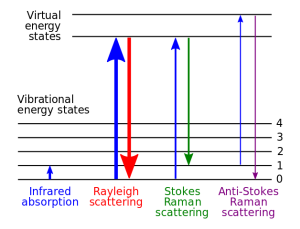
This spectroscopic technique which relies upon inelastic scattering of photons. Monochromatic light that is visible (i.e. not ultra violet or infra red) or x-rays is used from a laser source to interact with molecular vibrations, phonons or other excitements in the system. The energy of laser photons shift up or down as a result. We are informed about the vibrational modes in the system due the shift in energy.
Raman spectroscopy is usually used to identify structural fingerprint of molecules.
The Scope and Excitement of Physics
CV Raman Achievements
- Sir CV Raman was awarded Nobel Prize for Physics for his work – Raman Scattering and Raman Effect in 1930.
- The government of India has honored CV Raman with Bharat Ratna the highest civilian award of India in 1954.
- His other prominent achievements include
- Fellow of the Royal Society in 1924 and knighted in 1929
- Franklin Medal in 1941
- Lenin Peace Prize in 1957