


Test Papers – National Board Exam (IX-X)

All you want to know about Computer Science Engineering
In the initial days, computer science was being taught as part of maths and engineering subjects. This subject later has emerged as a separate engineering field. A Computer Science Engineer is skilled in programming languages, program design, software, and computer hardware. They also have basic knowledge of electrical engineering, mathematics, and linguistics.
Computer Science has been a growing field since its inception. The candidates who intend to opt for course should have minimum eligibility criteria as per the post applied for. Computer Science engineers are qualified to deal with the software and hardware of programming computers and laptops.
Qualification and Eligibility for Computer Science Engineering:
The preparation for CSE can be started from Class X. The secondary school subjects lay foundation for preparing the students for the upcoming entrance exams. The students should have Maths, Physics and Chemistry as their subjects in Class XII. Many parents start coaching from an early stage to master them in basics of the subject and also to get good rank in the entrance exams. Degrees from a reputed organization can help students get direct placements after completing the course. The companies pick bright students with good package. It becomes easy for a fresh graduate to climb the ladder faster provided the start is good. Students should have following qualification and eligibility to be a Computer Science Engineer.
Diploma: 10+ 2 passed candidates can join a diploma course; the duration of course can vary from 2 to 3 years
Bachelors Degree: The candidates are required to pass 10+ 2 and should have scored well in entrance exams which are conducted at state and national levels to get admission in 4 years engineering course. IITJEE, AIEEE, BITSAT are the major entrance exams to get admission in reputed college.
Master’s degree: The candidate should have a valid bachelors degree in computer science engineering and must have qualified GATE entrance test.
PhD: The candidates who intend to study further can join PhD programs which are offered by various universities and colleges across the nation.
Apart from regular courses students can also add degrees to the portfolio in distant modes, increasing their value and worth in the market.

Subjects of computer science engineering:
The major subjects of computer science engineering are
- Cloud Computing
- Compiler Design
- Computer architecture and organization
- Computer Networks
- Data Base Management Systems
- Data Structures & Algorithms
- Design and Analysis of Algorithms
- Distributed Computing Systems
- Operating Systems (Unix Programming)
- Software Testing
Skills of Computer Science Engineer:
Inorder to be a successful professional the candidates have to be proficient both at the subject and the soft skills. Subject knowledge helps you in overpowering the technical situations and soft skills help you in maintaining a good team relation. Here are few skills which a computer science engineer must have
- Mathematics: The computers run based on data, which is the mathematics. A computer engineer should have excellent maths. A person has to be good in maths inorder to understand and solve problem associated with the software and hardware.
- Software Engineering: This is the basic profile of a software engineers. They are responsible for designing, write the code and debug the software’s. A software engineer should be able to perform successful test procedures.
- Computer Hardware: A software engineers is well-versed with the comments of computer. Not just Windows computer but also Mac, Linux and other advance versions.
- Programming Languages: The candidate has to be proficient in computer programming languages and should equip with the latest versions. There are a number of programming languages to create computer programs. The advanced languages are SQL, JAVA, Java Script, C #, Python, PHP, C++, Ruby on Rails to name a few.
- Problem solving skills: The engineers should be good in handling troubleshooting in a short span of time. The candidate should be able to identify the problem and take measures to avoid the problems in future. The root cause of the problem should be solved to avoid recurrence of the issues. Small mistakes in programming can ruin the entire program. Computer coding is important in programming of the software. Computer science engineers should master trouble shooting and problem solving skills.
- Learning: It is a continuous process. Learning does not just means having qualification, it is about learning new software updates and the hardware launched in the market. The employer looks for the candidates who are quick learners and master the skills soon.
- Communication Skills: All individuals have to work in co-ordination with team members. Lack of communication can result in failure of the project and will hinder the team progress. An efficient communication is important for problem solving.
- Patience: Coding is the most important aspect of computer science engineers’ job profile. The candidate has to patiently sit at one place and continue coding the whole day. Patience is key to success to especially in cases of trouble shooting.
- Management Skills: It is quite important in any industry. It is important to manage the work as per the schedule and coordinate with all the team members for better outcome. Management skills are important to get promoted in the organization.
These skills of Computer Science Engineer make him an ideal candidate for the high posts!
Job Description:
A computer science engineer is trained and experienced in
- Design and development of software application
- Design and development of the hardware components of computers & laptops
- Manages the software, hardware & networks
- Writes code and algorithms for operating systems like Windows, Linux etc.
Career Options of Computer Science Engineering:
A computer science engineer can find placement in a number of industries which offer a decent pay package. The Career Options for Computer Science Engineers along with the profiles is mentioned here
- Software Developers:They are involved in various processes of software development such as design and coding, computer programming, project management, etc. The engineer has to be proficient in programming languages
- Hardware Engineers:They design, develop, test, and install computer hardware (computer chips, circuit boards, systems, modems, keyboards, and printers).
- System Designer:Professionals involved in system designing, Logical & Physical Designing. Logical designing can be performed with the structure & characteristics such as output, input, files, database & procedures, etc.
- System Analyst:They research and analyse the existing problems and execute solutions for the problem. Computer Science Engineers helps company develop the software and recommend software updates and coordinate between business development teams.
- Networking Engineers: Designing, implementation, and troubleshooting of computer networks.
- Database Administrator (DBA), Database Coordinator or Database Programmer in IT sector:Design, implement, maintain and repair an organization’s database.
A qualified computer science engineer can get job in big companies such as Google, Yahoo, Hewlett-Packard, International Business Machines Corporation and Toshiba Corporation.
Download Important Facts & Formulae for JEE

Heat Class 10 SSC
Topic covered under the 10th class physics text book is Heat. To get the in-depth knowledge the students can also search for heat chapter class 10 pdf.
Heat
Heat is the transfer of kinetic energy from one medium or object to another, or from an energy source to a medium or object. Such energy transfer can occur in three ways: radiation, conduction, and convection.
Conduction
Conduction is the transfer of energy in the form of heat or electricity from one atom to another within an object by direct contact.
Convection
Convection is a type of heat transfer that can only happen in liquids and gases, because it involves those liquids or gases physically moving.
Radiation
Direct transmission of heat or electromagnetic energy through space or another medium is called Radiation.
Difference Between heat and temperature
| Heat | Temperature |
| Amount of energy in a body | Measurement of intensity in a body |
| Flows from hotter to cooler object | Rises when heated and falls when cooled |
| Unit is Jules | Unit is Kelvin |
| Device used to measure: Calorimeter | Device used to measure: Thermometer |
| Symbol: Q | Symbol: T |
| Total kinetic and potential energy contained by molecules in an object | Average kinetic energy of molecules in a substance |
Latent Heat
Latent heat is the heat energy per mass unit required for a phase change to occur.
Regelation
Regelation is the phenomenon of melting under pressure and freezing again when the pressure is reduced.
Anomalous Behaviour of Water

The volume of substances increases on heating and decreases in cooling; but when water is heated from 0 degree Celsius to 4 degree Celsius, its volume decreases and increases only after 4 degree Celsius. This unusual behaviour of water from 0 degree Celsius to 4 degree Celsius is known as anomalous expansion of water.
Hope’s Apparatus
Hope’s apparatus is designed to show that water has a maximum density at 4°C.


Average Salary of a CA in India
CA, aka Chartered Accountancy is one of the most difficult courses in India. The difficulty level in passing the examination is on par with the competitive exams conducted by top management schools and B-schools. Being the most honored profession, that has immense scope, many think about the average salary of a CA in India.
Many factors influence the salary of a chartered accountant.
- Nature of Job / profile
- Type of firm and size of the firm / business
- Number of attempts
- Place of work
The average salary of a CA in India is 7.5 lakhs per annum, which may range from 4lakhs to 8 lakhs per annum, based on above factors.
Place of work is the most influencing factor in income earned by a CA. CA salary in Mumbai may have a huge difference when compared with a CA salary in Kerala.
Average Salary of a CA in India in case of Own Firm
Many students prefer to join in a CA Firm or other types of businesses to gain more experience. The article ship, work experience, and knowledge determine the salary, rather earning per month. A practicing chartered accountant can earn nearly about a lakh per month.
Average Salary of a CA in India in works in a CA Firm
Many medium and big sized firms hire the fresh chartered accountants who completed their article ship successfully.
Fresh chartered accountant salary on an average basis is 4 lakhs per annum. In case of big firms, with proven track records, fresh CAs get the package of about 8 to 10 lakhs per annum.
Average Salary of CA in India in other Type of Companies
Apart from the CA firms and own practice, many fresh CA graduates join different types of companies, which range from banking to IT sector.
Banking sector companies and Public sector companies pay a salary range from 4lakhs to 8 lakhs per annum for CA in India. In case of private banks, the salary is offered on par with the average MNC package.
Fresh chartered accountant salary, you can easily enroll in a MNC or IT Company with a lucrative package starts from 7 to 8 lakhs per annum. CAs with excellent track record is hired even for a salary of more than a lakh per month.
Highest salary of CA in India, hired by Bharti Airtel is 34.5 lakhs per annum. In case of international posting, recently three fresh CAs were hired for the whopping package of 70 lakhs per annum. A candidate from ICAI campus recruitment November 2010 batch was hired and fresh chartered accountant salary package is 70 lakhs.
Based on the size and nature of the company, the starting salary ranges from 4 lakhs to 12 lakhs per annum, in India. It is just a starting point and needs a lot of continuous learning.

Ohm’s Law
Ohm’s law is the biggest part of the Electricity class 10 NCERT solutions. Probably, an important section that all class 10 students should understand the concept perfectly.
Georg Ohm, a Physicist from Germany published this law. He discovered that electricity pass through resistor, which is directly proportional to resistor and voltage.
Ohm’s law indicates the potential difference between two points, the current through conductor is directly proportional to the electric current across those two points.
On any given constant temperature, the electricity flow proportional through linear resistance based on the voltage applied and inverse proportional through the resistor.
The term Ohm denotes a Greek letter’Ω’. 1 Ohm R (Resistance) is equal to 1 A current flow through the conductor between two points, which has the potential difference and is equal to 1 V.
Equation
Ohms law class 10 equation
It is one of the equations used widespread in a majority of electronic calculations. So it is essential for the students to understand it properly and remember accurately. Electricity class 10 NCERT solutions are helpful for the students to grasp the core.

- Current – I (electricity circuit), measured in Amperes
- Voltage – V (Potential differences across the end points), measured in volt
- Resistance – R (Constant of Proportionality), measured in Ohm
- Amperes – A
Many times, it is easier to remember the Ohms law using the pictures. Below are the triangle pictures for each element, which is collectively called OHMs Law Triangle. It will be easy to remember the Ohms law class 10 equation, through pictures. The arrangement of the elements represents the position within the ohms law formula.
Ohm’s law details about understanding the relationship between the electric current, voltage, and resistor.
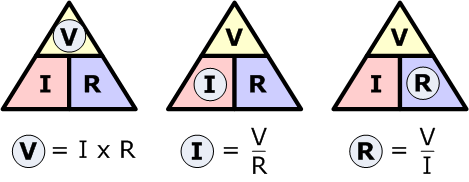
Voltage
To find the Voltage, ( V )
[ V = I x R ] V (volts) = I (amps) x R (Ω)
Current
To find the Current, ( I )
[ I = V ÷ R ] I (amps) = V (volts) ÷ R (Ω)
Resistance
To find the Resistance, ( R )
[ R = V ÷ I ] R (Ω) = V (volts) ÷ I (amps)
Resistance of any conductor refers to the property of the conductor which opposes the flow of charge.
Ohms law is very easy to understand and simple to execute. You can work with electrical circuits with different applications of Ohms law. It is an indispensible part of the instrumentation world.

Albert Einstein
Albert Einstein, a theoretical physicist from Germany stands as the strong foundation to the modern physics. His theory of relativity is the pillar of the physics. He is also known as a great philosopher.
Einstein is revered universally for his theories and equations. The three major works include,
- Einstein Field Equation
- Theory of the relativity– the world’s most popular equation and
- Law of photoelectric effect
His theories and discoveries laid the foundation for developing quantum theory.
Work Profile
After graduation, who excelled in Math and science, struggled a couple of years to get a teaching job. He joined as a Patent Clerk in Swiss Patent Office, in Bern to have a steady flow of income. Working as a clerk, he embarked a great journey and explored an extraordinary career in the world of science.
He earned his doctoral degree in the year 1905. He published four scientific papers, which has its significance even after 100 years. He introduced the new and special concepts of Photon theory of light and special relativity.
Explanation of the Einstein photoelectric effect earned all the essential attention towards him. It literally shook the whole world.
Einstein Field Equation
Einstein field of equation, precisely termed as EFE, it is a set of 10 equations derived by Albert Einstein. Einstein field equation explained here.
The equation denotes the general theory of relativity founded by Albert Einstein, which describes the basic interaction of gravity towards spacetime, when curved by energy and mass.
The EFE is written as
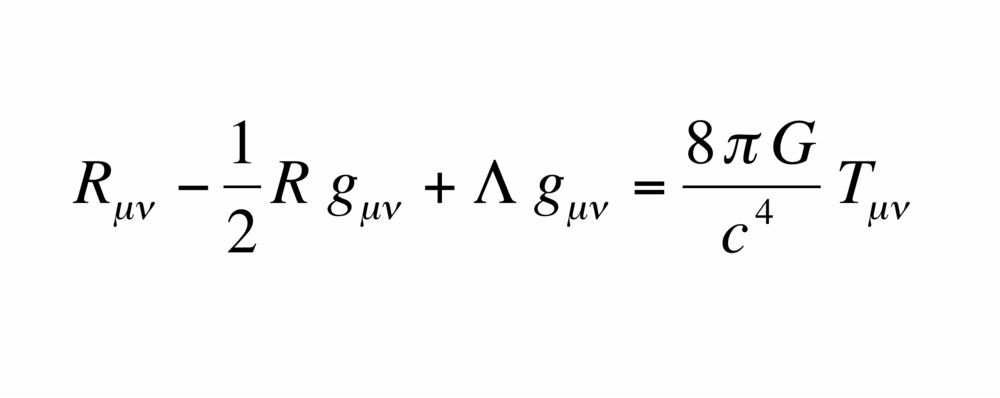
The tensor in EFE relates to a set of 4 x 4 symmetric tensors. Each tensor composes of 10 independent objects.
Explanation of photoelectric effect
The photo electric effect is a common phenomenon, where the metal surface emits the electrons upon light of adequate frequency. It was founded by Heinrich Hertz in the year 1887. Later, in 1092, Lenard also found it. However, electromagnetic theory of Maxwell could not connect with the both their observations of the photoelectric effect.
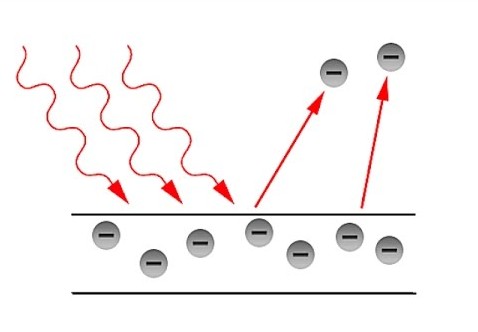
The view of Einstein photoelectric effect has an easy explanation and solved this problem.
He used Planck’s idea. According to the revolutionary idea, light is considered a particle. The energy level carried by any particle is based on the frequency of the light. Here, light is a particle and carries photon or quanta.
He framed an equation for the Einstein photoelectric effect E = hv
- E represents Energy
- h is Planck’s constant
- v is frequency of the energy radiated
Theory of Relativity
E = mc2!
The equation, E = mc2 depicts that mass and energy are interchangeable. It was developed by Einstein in the year 1905. This theory of relativity forms the foundation of the modern physics.
Probably a confusing theory of Einstein that most students may fail to understand the core. Theory of relativity simplified here.
The theory determines that the laws of physics apply equally to all non-accelerating observers. He demonstrated with an example:
Speed of the light in a vacuum remains the same regardless of the speed in which the observer travel.

NCERT Solutions for Class 10 Science Chapter 5 – Periodic Classification of Elements
In general life, the classification of things as per their size, shape, usage and other sorting criteria is important to live systematically. Similarly, the classification of elements has always been considered important in order to understand similarities, reactabilities and compounding possibilities of the elements. The 19th century and early 20th century witnessed considerable progress in the field of classification of elements.
Dobereiner’s Law of Triads
In 1817, German scientist J W Dobereiner proposed that the elements occur in groups of three when arranged in increasing order of atomic mass. He called every such group a triad. According to him, the atomic weight of the middle element is almost same as the average of the atomic weights of the other two elements. According to him, all the elements of a triad have similar chemical properties.
Example: Triad 1
| Element | Lithium (Li) | Sodium (Na) | Potassium (K) |
| Atomic Mass | 7 | 23 | 39 |
The average of masses of Lithium and Potassium gives the atomic mass of Sodium. All the three elements have similar chemical properties.
Newland’s Law of Octaves
In 1864, English chemist John Newlands presented tabular classification according to increasing order of their atomic masses. He arranged the elements in groups of seven as according to him, every eighth element in the table showed physical and chemical properties similar to that of the first one. His arrangement of elements was called octave.
Example:
| Li | Be | B | C | N | O | F |
| Na | Mg | Al | Si | P | S | Cl |
| K | Ca |
The physical and chemical properties of Li, Na and K are similar to each other.
Mendeleev’s Periodic Table
In 1869, Russian scientist Dmitri Mendeleev proposed the most successful classification of elements in order of increasing atomic weights. According to him, “properties of elements are periodic function of their atomic weight.”
Mendeleev explained that the gaps in his table are for yet to be discovered elements. His claim proved right with discovery of Gallium which he had kept as undiscovered eka-aluminium and scandium which he kept as eka-boron.
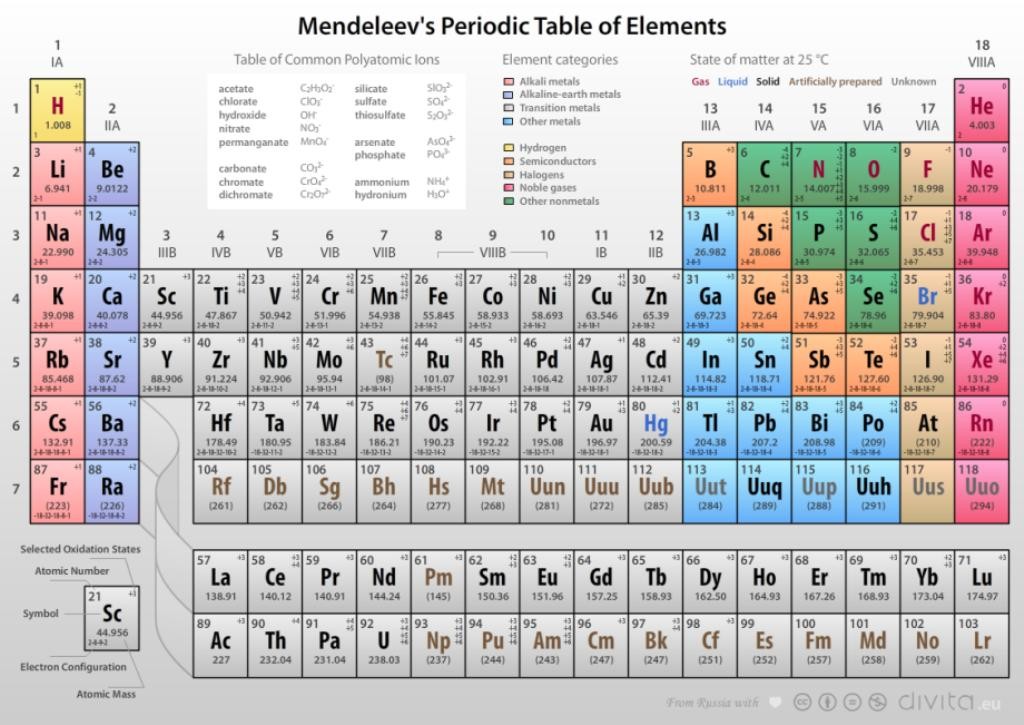
Mendeleev Periodic Table
In Mendeleev’s table there are 6 horizontal rows known as periods and 8 vertical rows called as groups. Elements in one group have similar properties.
Henry Moseley’s Modern Periodic Table
In 1913, British scientist Henry Moseley proposed that the elements should be arranged in order of increasing atomic numbers instead of atomic weights. According to him, properties of elements are a periodic function of their atomic numbers.
According to the modern periodic law, if the elements are arranged in order of their atomic numbers then the elements with similar properties are repeated at a regular interval.
The modern periodic table has 7 horizontal rows or periods and 18 vertical columns.
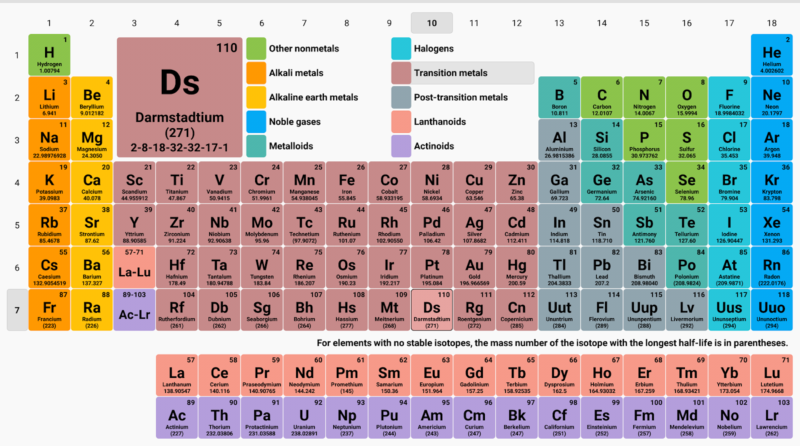
Modern Periodic Table
Trends in modern Periodic Table
-
Valency and electronic configuration
All elements in a group have same valency. The group number represents the valancy with respect to oxygen.
Moving across a period from left to right the valency increases from 1 to 8.
-
Atomic Size
Atomic size increases while moving downwards in a group. While moving from left to right in a period, the atomic size decreases.
-
Metallic and Non-metallic Properties
While moving downwards in a group the metallic property increases gradually. While moving from left to right in a period, metallic properties gradually decrease. It means that the elements on the left are true metals and on the right are true non-metals.
-
Electro-negativity
While moving downwards in the group the tendency of gaining an electron decreases.
NCERT Solutions for Class 10 Science chapter 5 – Periodic Classification of Elements