

Test Papers – ICSE – Class – X

Joint Entrance Exam(JEE) Is An Exception For The Participants
The Joint Entrance Examination(JEE) is a highly competitive examination which is jointly conducted for obtaining admission to the IIT’s and the engineering colleges under the guidance of the board. The performance of the candidates provides a clear idea about those students that have the eligibility to take admission in the engineering colleges although the selection is done rank-wise. Therefore, the students with higher ranks have a better chance of gaining admission to the colleges under the zonal IIT’s and the state run engineering colleges in India. Students can take this examination after completion of Class XII or the Senior Secondary Examinations that are conducted by the state boards as well by the other boards such as CBSE.
Getting on with the basics
With exceptional knowledge of solving the most critical problems of Mathematics and Physics, the students can get ahead in life by pursuing a career in engineering. Read the following points.
- The Joint Entrance Examinations(JEE) are conducted with an objective to bring into limelight some of the extraordinary talents present in this country with respect to the field of engineering.
- In this examination, the students get an opportunity to write the examination in a multitude of topics including Physics, Chemistry and Mathematics.
- The students with high level of merit in Mathematics and Physics can hope to get high score and rank that can help them accomplish their aim.
- The advanced results of Joint Entrance Examination(JEE) allow the students to check in to the website of the board and view their results to get an idea of the positions that they have secured. However, only those students can make the most of this option that secure a specific rank. Incidentally, more students participate in this examination every year when the medical aspirants are not taken into consideration.
- A lot of people view this examination as a stress inducer although the idea may not be correct keeping in mind the opportunity that the students get by writing this examination and securing a career of their choice.
- The examination has a specific format that allows the students to follow it for writing the examination. However, the pattern of the paper in JEE Advanced 2016 may vary although there are two papers in which the students have to appear mandatorily.
- The exam comprises multiple choice questions with four options from which each student has to select the best option.
Preparation for JEE ADVANCED
To prepare for Advanced JEE, the students are advised to consider taking the mock and practice tests as time can make all the difference when it comes to obtaining high ranks. In addition to this, they have to analyze the strong and weak points to identify the areas in which they have to work up with better efforts. A lot of students choose the option of selective study before taking this examination although the papers of this test are prepared by experts and it can be a hard nut to crack unless you have requisite knowledge for taking the tests in the subjects that have been specified by the board. The syllabus of this examination includes a part of the contents that are taught in Class XI and XII for establishing a career in the field of engineering.

Pursuing A Fascinating Career In Engineering With JEE Advanced Examination
For engineering aspirants in India, the first hurdle that the students must consider is the Joint Entrance Examination which is a common entrance test for the students. In fact, this exam also targets those students that are eager to take admission in the zonal IIT’s the most eminent engineering institution in India. This examination is held in two phases. While the first one is called JEE Mains Examination, the second phase is JEE Advanced. The other technical institutes that are included for admission in this examination are National Institute of Design, Institute of Engineering Science and Technology Shibpur and the Central Funded Technical Institute. However, not all students have access to the advanced examinations that are held before the mains.
Things to know
Which candidates can take JEE Advanced Examination and what is the implication of this test? Out of the students that take this examination every year, around 1.5 lakh students can take the advanced tests. Take a quick look at the following points.
- Not taking the JEE Advanced Examination does not mean that you have reached the end of the road while pursuing a successful career in engineering. You can still get into some of the top engineering colleges.
- The JEE Advanced Examination is meant for those students that are keen to take admission to the IIT’s and the Indian School of Mines Dhanbad.
- Those candidates that fail to get the requisite marks in Advanced JEE are not considered for admission to the IIT’s and have to consider the option of other engineering colleges.
- The Advanced Examination comprises of two papers. While the first paper includes Engineering, the second paper is that of Architecture or Planning. There is negative marking in this paper and every question is equal to four marks and each wrong answer implies that a candidate has lost four marks.
- The subjects of the first paper include Physics, Chemistry and Mathematics and the second part is related to drawing and architecture.
- The students can view the JEE advanced results by checking into the website with their roll number and date of birth to get an idea about their rank and placement. Those students that secure the highest rank in this examination get admission to the top IIT. Therefore, the rank obtained in this test can affect the placement of the students as far as choosing the technical institute is concerned.
Do not forget
Satisfying the eligibility criteria is necessary for taking JEE Advanced Examination. The results of Class XII are used for determining whether a candidate is eligible to take JEE Mains which is taken at first followed by JEE Advanced for picking the right candidates. Securing 75% makes a student eligible for the Mains and the candidates must ensure that they fulfill the eligibility criteria for admission to take the test. For a golden and bright career in the field of engineering, getting on with the preparation and taking the exam with conviction can take the students through the path of success. With high cut off scores and stiff competition in this field, taking JEE Advanced is the gateway to success but only when the students are fully prepared to take the challenge.

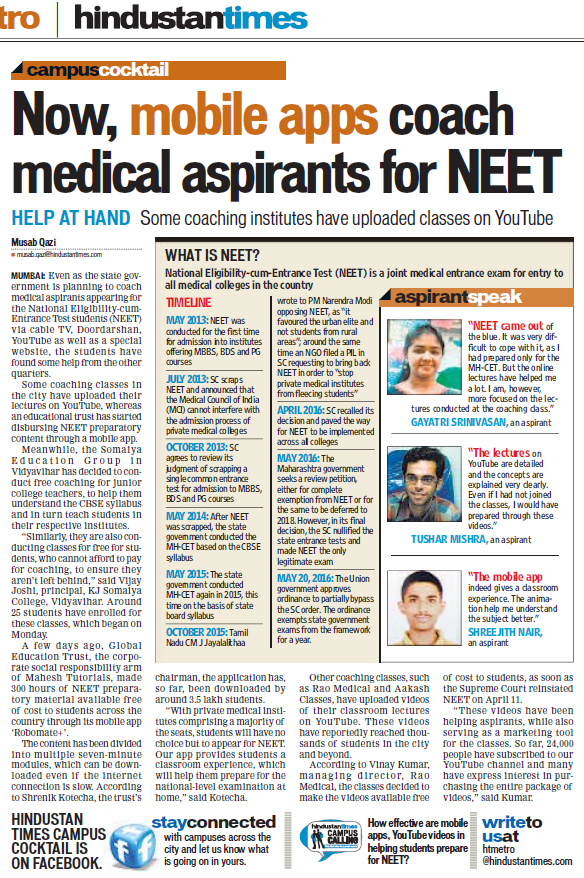
NEET And The Fate Of Private And State Medical Colleges
The National Eligibility Entrance Test (NEET) will not play with the fate of the students as much as it will affect the private and the state colleges. Before the directive of the Supreme Court came into effect, the students had to take an examination at the all India level for taking admission into the top notch medical colleges that are run by the Central Government. The students were to take a separate examination for the state run medical colleges. However, the scenario has altered with the implementation of this rule and it is made for to serve better purposes for the students and the convenience of the authorities to conduct the examinations.
Benefits of NEET
While the directive of the Supreme Court is not likely to affect the fate of the students, it will certainly have an impact at the way in which the entire system functioned at the state level. However, the truth is that the students will also benefit with the implementation of this rule despite the fact that they are apparently in a state of confusion after the roll-out of this rule. The following points will illustrate.
- The misuse of the entire system in which large amount of capitation fees were accepted by the private colleges for granting admission to the aspiring medical candidates will no longer remain in effect.
- The implementation of this rule will make way for better and transparent checking and it can be expected that the authorities will have better ways to manage a single entrance examination for the candidates living in India.
- Encouraging participation of meritorious students is another benefit of this system instead of affluent students taking the advantage of the capitation fees.
- Instead of filling multiple forms for taking each examination separately for central and state run medical colleges, students will experience less pain for the registration and filling of forms that are in place for NEET.
- Some of the renowned teachers have expressed positive views about this National Eligibility Entrance Test or NEET stating that it will enhance the concentration levels of the students and convenience in studying the state syllabus. Until now, in states like Tamilnadu, no entrance exams were held for taking admission into medical colleges, this examination will act like a sieve for considering those students that have the ability to make it to the top.
- It is true that in some states the medical colleges are compliant with corruption at the highest level and this step can help in reducing such incompetence to a great extent.
Getting relief from corruption
However, the confusion that still prevails in the minds of the students and the authorities must be dispelled with immediate effect thereby allowing both to get the respite which is the essence of taking a single examination for the aspiring medical candidates. The primary reason for which the private colleges have opposed this step as it will take a toll on their revenue. For students taking the advantage of the money taken by these colleges for granting admission, this directive of the Supreme Court to conduct a single examination can be a scary option. However, the society will benefit a lot eventually when this system is implemented with best effect.